Monday, February 8, 2016

Drilling and Testing Boreholes in Mulenje

This post is a follow up to two previous posts dated May 31, 2015 and July 19, 2015.  All three deal with the effort of developing water sources for Mulenje Community School and some of the surrounding communities.  The May post dealt with locating the boundaries of the Mulenje Village and the July post dealt with the locating possible sites for wells.  This post now starts to develop the water sources.  It has been hard work getting to the point where we can drill the 5 boreholes.  Convincing the people of the village that we are serious about helping them is a challenge since they don't have a lot experience with organizations providing help.  The other challenge is getting them to contribute funds for the establishment of the water points.  We have persevered for several months through this process and now have a project approved to develop their wells.  Now there is another type of hard work, manual labor.  We are removing the drill rods from the hole we just drilled.  You see it is easy work for the man with the white shirt and tie.


But then he has to sit back and observe.  I had the man that was sitting in the chair get up so I could sit down in his recliner and then he took my picture.  His first with a camera.  I thought he did a pretty good job for a beginner.
  

 Or maybe even take a nap in the shade of the hut.


After we finished drilling we took a break for the week-end and then started into pump testing and taking samples for water quality tests.  Here we are measuring the water level as the pump (generator operated submersible pump) is taking water from the borehole.  The yellow tape measure has a sensor on the end of it that sends a signal when it touches the water.  We record the water level at intervals so we know how fast the water level in the borehole is dropping.


 We also record the water level at intervals after turning off the pump to see how fast the water level is recovering in the borehole.


This one is flowing at about 1.75 liters per second.  We pumped out about 10,000 liters of water while we were doing our test.  This borehole could easily handle a submersible electric pump but there is no electricity anywhere near. 


Now it is time to stop in for a little relaxation.  We found this string instrument in the local Catholic church.  It is close to the school so we stop here because their pit latrine has a concrete floor.  It is the best in town, well maybe best in the bush.  


Finally it is back to work coordinating with the village on what they need to do so we can continue.  They just need to contribute a small amount to the expenses so that they can feel ownership of the well.  Oh well.  We can't break the culture either of the men sitting one place and the women somewhere else.  The water is for the women but the men want to dominate the control.  We require 50% participation from the women on the Water Committee.  


Sunday, February 7, 2016

Mom's Water Week

This post is about many experience with water the week of January 18 -24.  It started with a visit on Tuesday to Naluyanda Health Clinic where we have been trying to refurbish a solar well.  On the way we stopped for a short visit at the school.  There was a class room of students inside equal in amount to all of our grandchildren.  But outside there were another group of students and it didn't take long before they were being taught about the parts of the body.
 
 
We went to the Clinic to encourage their committee to collect funds so they could pay for part of the expense of repairing the well.  The amount needed is 600 kwacha which is equivalent to $55.   On Wednesday we traveled to Chongwe to meet our drilling company so we could take them to the sites in Mulenje.  We waited most of the day in Chongwe while they had 3 flat tires repaired.  With the help of our ace negotiator (CKB) we were able to convince them that they needed to go to Mulenje School and spend the night instead of returning to Lusaka.  That way they would be ready to drill in the morning.  We arrived, as promised, at 6 a.m. and waited for them to get ready.  Someone was real happy when they started drilling.
 
 
So while the drilling is going on what else is there to do.  We are drilling at the community school so there are children, some of which are there but can't go to school because they have no money for the school fees.  They are going to get taught something anyhow.
 

 Later in the day we moved the the second location, Nkhokoma community, to drill a second borehole.  We finished late that night but during the drilling you know who found Grama.  The kids.
 
 
This one was one of Mom's favorites.
 
 
 Because we started drilling this one late in the afternoon we left our site monitor there to stay with the locals overnight. We arrived home after 21 hour and then prepared to return the next morning by 7:30. Again we had to wait for the crew to get up and going. The next boreholes to drill was at Kapandila community. Here we set up by a big tree.
 
 
We drilled and then the excitement happened as they were flushing the well.
 
 
There was plenty of water and too much pressure and the poly pipe they were using to blow compressed air into the hole came flying out like a 60 meter long snake.  You don't want to get hit by that pressurized pipe.  We finished here and then moved on to the next site, Chindola B community.  It was late in the day when we started but the kids still found Grama.


We didn't finish that one the same day as they drilled but lost some of the casing in the hole when the glue failed to hold on one of the joints.  It was late and the men were tired so we stopped and returned the next morning at 6 to flush and then move to the last site, Mweetwa.  Here Grama and the kids found a front row seat as the action started.
 
 
And here we are at the end of drilling the last hole with Abinala Daka, the Mulenje Village Secretary; Steven Manyoma, the Village Advisor to the Head Woman; Darius Banda, our engineer; and the missionaries. 


That water was not to be out done.  We went to Matero Ward the next day, Sunday, to witness the baptism  of two of the children Mom had taught in Primary. All were Mom's water related events in one week.


Completing the Chilenje Maturation Kit Project

We continued to work on our Maturation Kit Project through October and November.  We held one more training at the Chilenje Homecraft Center in October and then one in November.  At the end of November we had a final production session at the Lusaka Stake Center with help from our Sewing Club.  When we finished we had made 128 kits.  The project took us four months to complete. It took a couple of months for me to complete this post.
 
The following pictures are a summary.


Chindalo is in the area where we have been working on construction of wells.  We gave 27 kits to Sarafina Chindalo (women with the blue top) to distribute to the women and girls in the community. Below is a list of the organization or individual who received kits, the kind of kit they received and the quantity they were given.


Sunday, December 6, 2015

Kabwata Cultural Village

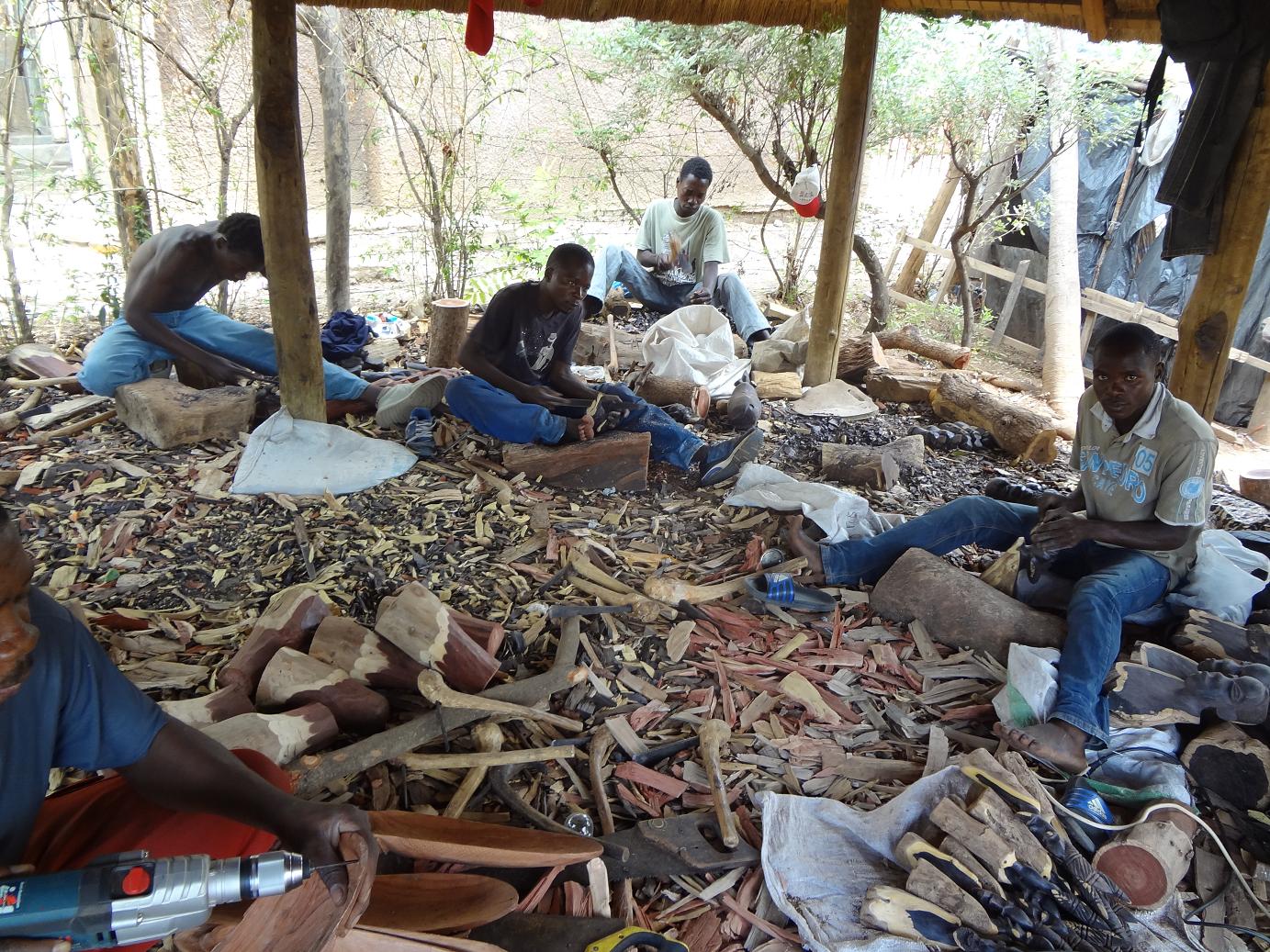
We finally visited Lusaka's own cultural arts village.  It is located in the Kabwata section of the city and is called the Kabwata Cultural Village.  Below is a picture of their sales area.
 
 
Several of the locals make the many items that are sold here and in the markets that occur on Holidays at a mall and the last Saturday of the month at the Dutch Reform Church.  Some items are nice works of art and others are mass produced to be sold as souvenirs.  The difference in the market at this location is that here is also the workshop where they produce many of the items. 
 
 
If you look closely you can see some of their tools mixed in with the wood shavings.   Here is a closer look at the hand tools.


This is a stock pile of their raw materials.
 
 
They do use some electricity in buffing the pieces they are making.
 
 
So what does the final product look like?  I didn't take any pictures of that.  I guess I was too interested in what their shop was like.  I do believe that many items are made elsewhere.  They all take turns working in the shop one day and then selling their items another day.


Sunday, October 25, 2015

Chilenje Maturation Kits

Last January when we were at training in Johannesburg, we heard about a project that had just finished in Kinshasa, Democratic Republic of the Congo.  The project involved 80 participants making 200 Maturation Kits to be given to young girls and women who had no affordable access to feminine sanitary pads. 

Maturation Kits Prepared in the DRC


Part of the Southeast Africa Area Welfare Department 2015 Plan has been to Empower Women to act instead of being acted upon.  In March, when we were able to start making our plans for 2015, we met with some women's groups in Lusaka to see what we could do to encourage these women.  They wanted sewing machines, business training and literacy training.  We could have given them sewing machines but they have no place to safely keep or use them.  In talking to some of the Community Development, Mother and Child Health staff we mentioned the possibility of helping the women make maturation kits.  They were receptive to the idea so we started making plans to do a project training 50 women from the community to make 120 kits. We were finally able to submit our plan to South Africa for approval after months of preparation and research into where to get the materials needed. Sister Bodily spent many hours making kits to determine the details of what and how it would work best for teaching the ladies how to assemble their own kits.

Here is our kit as we determined it should be made. 
  
 
To be able to make 120 kits you have to make 240 shields (item just below the panties) and 960 pads (the two stacks of items on the right and bottom).  From Sister Bodily's efforts we knew how much time it would take to do this and figured that we would need at least a couple of days to do the project.  We also needed help from a group that knew how to sew.  We came across some members that belong to a sewing club and they were willing to learn the process and then help with the project.  We requested from the Community Development staff a list of the names of 50 women that would be participating.  We finally received a list of 34 women.  We scheduled the dates for the project with Community Development and let them know where we would hold the project.  Because we only had names and no contact information we required the Comm. Dev. staff to notify the women when and where they needed to be for the workshop.   
 
We prepared the Sewing Club with at training meeting at the Labala building a week before the project.  Here Sister Bodily is teaching them the process. 


We arranged for the use of the Libala Church building and set up the Relief Society room as a sewing room and 4 other rooms to support the production. 
 
   
We also trained a District of missionaries to help us with coordination and quality control. 
 
 
The first day of the project we set up the building, the sewing club showed up and the missionaries came to work.  Unfortunately, the Comm. Dev. staff failed to inform the women that the project was happening so no one showed up to participate.  The sewing club and the missionaries worked all day and produced enough kits for the 15 members of the sewing club to take a kit home with them.  We cancelled the next day's activity because of lack of support from the government agency. 
 
We had even catered lunch for the participants.
 
 
We learned many lessons from our attempted project.  First, you have to find someone in the lowest level of government to help you with support.  Second, our ambition would have killed us if everyone had showed up.  It was a tremendous amount of work to get to where we were and we were exhausted after one day.  Third, the members of the church are more dependable than the members of the community.  So we had to regroup because we still have materials to make a lot more kits.  We ended up communicating with the local officers, whose names we were finally given after the project flopped.  We made plans with them to move forward. 
 
We moved the location of the project from the Church building to the local Homecraft Center.
 
 
Here we have trained 2 groups of 10 women each in 2 half day sessions. 
  
 
The participants are not able to complete an entire kit during our two, half day, workshops, but with the extra parts we have we are able to give them each a full kit at the end of the second day. We have now distributed half of our kits. 
 
Here are some happy recipients with their kits in hand. 


We will train a couple more small groups and then work with the sewing club to make the rest to donate to health posts/clinics where newborns are delivered, and rural areas where the women do not have the ability to learn to make their own kits. 


Sunday, August 30, 2015

Changes

 
Life was pretty normal in Zambia until the end of June.  The previous rainy season was short and had not produced enough run off to fill Lake Kariba.  Kariba is the world's biggest man-made reservoir by volume that straddles the Zambian and Zimbabwean border and supplies about 1,830 megawatts of power to the two nations when running at full capacity.  The dam was 40 persent full on July 19, less than half what it was a year ago, according to official data.  Fed by the Zambezi river, the reservoir is 226 kilometers (140 miles) long and as wide as 40 kilometers. 


Flood gates on the Kariba Dam between Zimbabwe and Zambia.
 
The low volumn of water has caused the local utility company to do what they call "Load Shedding". Power production is reduced by restricting the flow of water from the reservoir through the hydro-electric plant.  This means that customers do not have power supplied to them for several hours each day. In our case we are without power (which also means no water) for about 8 hours every day. It is either out between around 8 a.m. to 4 p.m. or from around 2 p.m. to 10 p.m.  We were spoiled with electricity everyday all day until this happened.  We struggled along for a few weeks and then decided that we had better start looking for some alternatives.  It appears that the chances of changes in the situation will not get better until the end of the year when the rain comes again.
 
So we researched generators.  You have to feed them constantly so we didn't need that added burden and expense.  We wondered what an UPS (un-interupted power supply) would do and we located some that worked off the utility power source and some that worked off of solar. 
 
In the mean time we found some little solar powered lights.  One side is a solar panel and the other side is an LED light.  They work very well for about 4 hours on a full charge.
 
 
That was helpful when the power was out after dark but it still didn't provide power for the internet and computer operations that we needed during the day light hours.  The decision was made to purchase an electric charged UPS system with battery back-up.
 
 
We can now have the internet on demand when there is no power as the inverter turns the DC power stored in the battery to AC power.  It also allows us to run a fan, lights and computer chargers.  Talk about being spoiled again.  Except there still is no water when the power is off as the pump and similar items with over 1000 watt needs will not work.  Water continues to be stored in empty 2 liter milk bottles so we can have cold water to wash or clean with. 
 
The other change came more suddenly this week.  We received a call from the Mission President on Wednesday to talk about our assingment to the Matero Ward, where we have been attending since arriving in Zambia.  In his monthly Interview with the Stake President they discuss missionary assignments to the Stake.  They counselled about some development of the Priesthood in the stake and concluded to change our assignment from the Matero Ward to the Lusaka Ward.  We are not sure what exactly we will be doing but the new couple (Elder and Sister Groesbeck) who arrived a week ago will fill in at the Matero Ward.  They will be great.  We will miss our friends in Matero.
 
This is Bishop Chifunda with his counselors and Ward Clerk.
 
 
From left to right: Brother Sakala, Ward Clerk; Brother Bwalya, 1st Counselor (he has been ill); Bishop Chifunda; Brother Kalonga, 2nd Counselor; Sister and Elder Bodily